How to Avoid Rogue Traders
Rogue traders cost UK residents millions of pounds every year — often targeting people in their own homes. This guide explains how to spot the warning signs, protect yourself, and stay safe when hiring local tradespeople.

Rogue traders cost UK residents millions of pounds every year — often targeting people in their own homes. This guide explains how to spot the warning signs, protect yourself, and stay safe when hiring local tradespeople.
Rogue traders cost UK residents millions of pounds every year — often by targeting people in their own homes. This guide explains how to spot the warning signs, protect yourself, and stay safe when hiring local tradespeople.
Rogue traders cost UK residents millions of pounds every year — often by targeting people in their own homes.
This guide explains how to spot the warning signs, protect yourself, and stay safe when hiring local tradespeople.
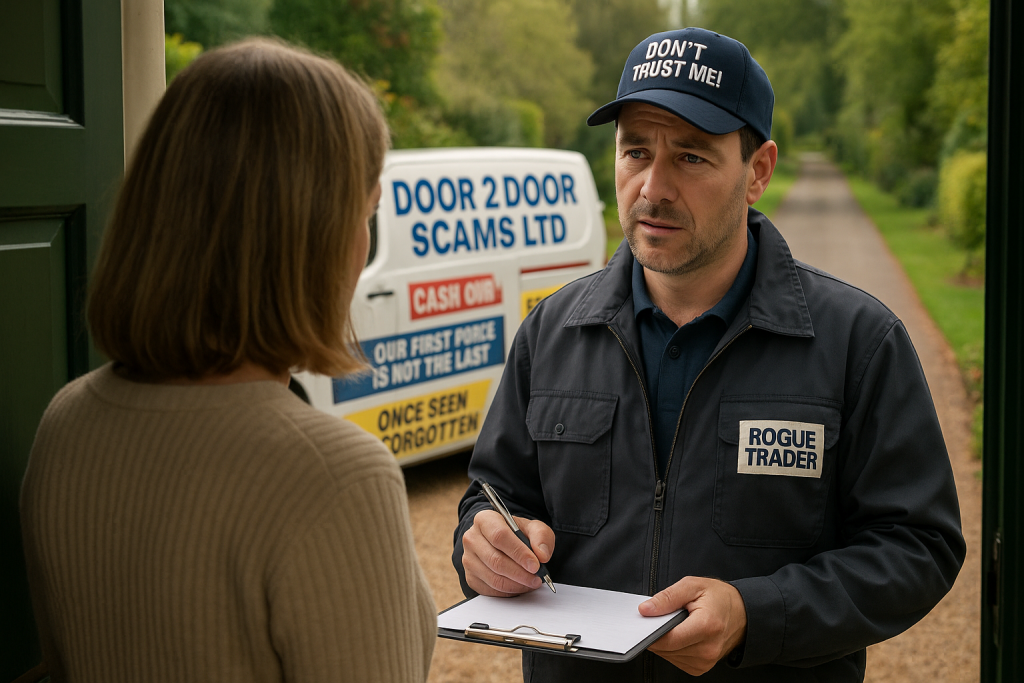
Recognising the warning signs early can stop you from falling victim to a rogue trader. Here are the most common red flags to look out for when someone approaches you with services at your home.
Rogue traders often turn up out of the blue, offering to fix a problem you didn’t know you had. They may claim to be “working in the area” or say they “noticed an issue” with your roof, driveway or guttering.
Legitimate tradespeople do not go door to door looking for work — this is one of the biggest warning signs.
A common tactic is to create urgency: “This needs doing today”, “We’ve got leftover materials”, or “The price will go up if we leave”.
These statements are designed to stop you seeking a second opinion.
A reputable trader will give you time to think, compare quotes and make an informed decision.
Rogue traders prefer verbal agreements so they can change the price later.
If someone avoids writing down costs, materials, or timescales — or says “don’t worry, we’ll sort it as we go” — treat it as a major red flag.
All trustworthy tradespeople expect to provide written details.
It’s normal for some trades to ask for a small deposit, especially if materials need to be ordered.
But demanding full payment upfront before any work begins is a major red flag.
Rogue traders often disappear once they’ve received payment, leaving the job unfinished or never started at all.
If someone becomes evasive, vague or irritated when you ask basic questions about cost, materials, insurance or timeframes — walk away.
Professional tradespeople expect questions and are happy to explain their process clearly.
Some rogue traders use ID cards that look official at first glance but don’t match their company or qualifications. They may show them only briefly or try to distract you from reading them properly.
They may claim to be trained or accredited but can’t show any proof. If someone avoids showing certification or says it’s “in the van”, it’s a concern.
Every legitimate trader should have valid insurance. Rogue traders often avoid the subject or claim they “don’t need it”.
If there is no insurance in place, you could be liable if anything goes wrong.
A lack of traceable business information — no landline, no address, no business name — is a major warning sign.
Rogue traders rely on being uncontactable once they’ve left.
Legitimate businesses usually have at least a basic online footprint (Google listing, website, reviews, social media).
Rogue traders often have no trace at all or constantly change names to avoid accountability.
If a number keeps changing, looks unusual, or cannot be found online, it may be a temporary number used to avoid tracing.
If they refuse to leave behind quotes, receipts, or invoices — or the paperwork looks generic with no address or registration — be cautious.
A lack of paperwork makes it difficult to resolve disputes or prove what was agreed.
Rogue traders often start with a very low price to gain trust. Once you agree, the cost can suddenly rise due to “unexpected problems” or “extra materials needed”.
If a quote is much lower than everyone else’s, it usually means corners will be cut — or the trader plans to increase the price later.
Insisting on cash is a tactic to avoid providing receipts or traceability.
It also leaves you with no protection if things go wrong.
A genuine trader may ask for a small deposit, but anything large or unexpected is a strong warning sign.
Rogue traders often take the deposit and do not return.
They may start the work at a low cost, then claim problems have been found and increase the price dramatically.
This tactic is used to pressure homeowners into paying more once work has already begun.
Professional traders accept staged payments linked to clear milestones.
If someone demands the full amount early or refuses to take staged payments, it’s a red flag.
Without a proper invoice, you have no proof of work carried out, no evidence of payment, and no way to pursue complaints.
All work should be followed by documented paperwork.
Use this quick checklist whenever you get quotes for work on your home. If too many boxes stay unticked, it’s a sign you should walk away and find another trader.
JustGoLocal.co.uk aims to provide helpful advice and resources so you can make informed decisions when choosing tradespeople or builders. However, any decision to hire a business is entirely yours, and JustGoLocal.co.uk cannot accept responsibility or liability for the businesses you choose to engage with.
Our goal is to give you the tools and guidance to help you achieve a successful and positive experience. Please use these guidelines as a starting point, but always carry out your own checks and due diligence at every stage of your project.